
Apr . 04, 2026 02:05 Back to list
Understanding Deep Groove Ball Bearing Imperial Sizes for Optimal Performance
Understanding Deep Groove Ball Bearing Imperial Sizes
Deep groove ball bearings are arguably the most widely used type of rolling-element bearing. Their versatility makes them ideal for a vast range of applications, from electric motors to automotive components. When sourcing these bearings, particularly for applications requiring compatibility with existing imperial (inch-based) systems, understanding deep groove ball bearing imperial sizes is crucial. This article provides a comprehensive guide to these sizes, their applications, and considerations for selecting the right bearing for your needs. Properly specifying the size is paramount for smooth operation and longevity of your machinery.

The Fundamentals of Imperial Bearing Sizes
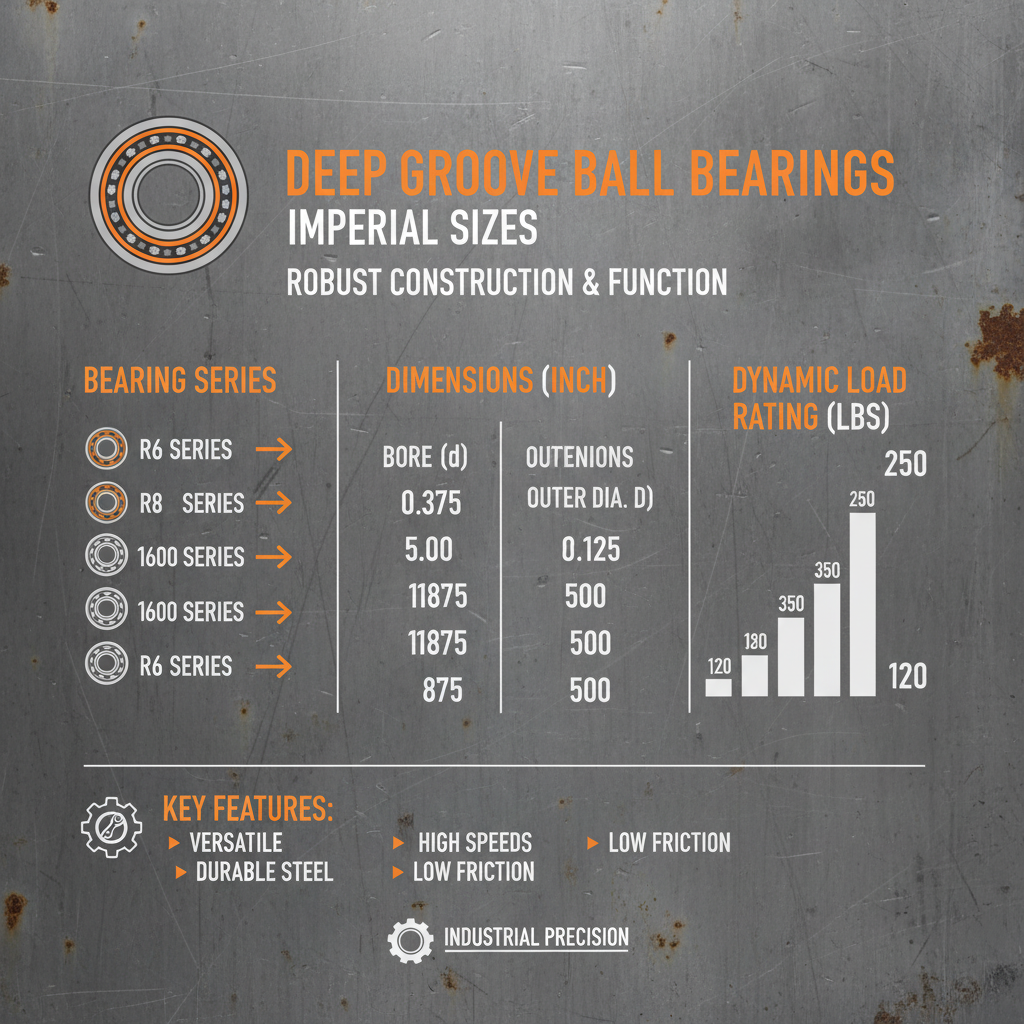
Imperial bearing sizes are expressed in inches. Unlike metric sizes, which are straightforwardly based on millimeters, imperial sizes can seem less intuitive. The key dimensions to consider are the bore (inner diameter), the outer diameter, and the width. These dimensions are typically specified as fractional inches (e.g., 1/2 inch, 3/4 inch, 1 1/4 inch). When selecting a bearing, it's critical to verify these dimensions align with your application's requirements. Precise measurement and accurate specification are crucial to avoid interference or looseness.
Key Takeaway: Imperial bearing sizes are defined by their bore, outer diameter, and width, all expressed in inches (often as fractions). Precise measurement is essential.
Common Deep Groove Ball Bearing Imperial Sizes
Several imperial sizes are commonly encountered in deep groove ball bearing applications. These include, but aren’t limited to, 1/4", 3/8", 1/2", 3/4", 1", 1 1/4", 1 1/2", and 2". Each size corresponds to a range of bearing series and load capacities. The specific designation (e.g., 608, 6205) indicates not only the size but also the bearing’s internal construction and precision class. ARY Bearing offers a comprehensive range of these common sizes.
Deep Groove Ball Bearing Imperial Sizes vs. Metric Sizes
While metric bearings are increasingly prevalent, many applications still rely on imperial sizes. Converting between imperial and metric can be challenging due to the lack of a direct, clean conversion. Approximately, 1 inch equals 25.4 millimeters. However, simply converting the inch value to millimeters isn’t sufficient for bearing selection. You need to find the closest equivalent metric size, considering tolerances and interchangeability. ARY Bearing provides conversion charts and expert advice to assist in these scenarios.
Factors to Consider When Choosing Imperial Bearings
Several factors influence the best choice of deep groove ball bearing imperial sizes. These include load capacity (radial and axial), speed requirements, operating temperature, and the presence of contaminants. Bearings with larger bores and outer diameters generally have higher load capacities. Precision class (ABEC rating) impacts running accuracy and noise levels. Selecting the appropriate bearing material (e.g., steel, stainless steel) is vital for compatibility with the operating environment.
Sourcing High-Quality Imperial Bearings
Choosing a reputable supplier is paramount. Low-quality bearings can lead to premature failure, costly downtime, and even safety hazards. Look for suppliers that adhere to industry standards, offer comprehensive product documentation, and provide technical support. ARY Bearing is a trusted provider of high-quality deep groove ball bearings in both imperial and metric sizes, backed by expert support and a commitment to customer satisfaction.
Conclusion: Selecting the Right Imperial Bearing
Understanding deep groove ball bearing imperial sizes is essential for ensuring optimal performance and reliability in your applications. By carefully considering the factors outlined in this article and partnering with a trusted supplier like ARY Bearing, you can make informed decisions and minimize the risk of bearing-related issues.
Frequently Asked Questions (FAQs)
What is the difference between a 1/2" and a 1/2" imperial bearing?
While both indicate a 0.500" bore, the full bearing designation (e.g., 6205) provides crucial information about the bearing's dimensions, load capacity, and precision class. Different series with the same bore can have different outer diameters and widths. Always refer to the complete bearing specification to ensure compatibility. For example, a 6205 bearing will have different dimensions than a 606 bearing, even though both have a 1/2" bore.
Can I substitute a metric bearing for an imperial bearing?
Substituting a metric bearing for an imperial bearing is possible in some cases, but it requires careful consideration. You need to find the closest metric equivalent, taking into account tolerances and interference fits. It's often not a direct one-to-one replacement. Incorrect substitution can lead to bearing failure or reduced performance. Consulting with a bearing specialist is highly recommended.
What is the ABEC rating, and how does it relate to imperial bearings?
ABEC (Annular Bearing Engineers' Committee) rating is a standard that defines the tolerance levels and running accuracy of ball bearings. Higher ABEC ratings (e.g., ABEC 5, ABEC 7) indicate tighter tolerances and smoother operation. This is applicable to both imperial and metric bearings. However, ABEC rating isn’t the sole determinant of bearing performance; material quality and lubrication also play a critical role.
Where can I find detailed specifications for deep groove ball bearing imperial sizes?
Detailed specifications for deep groove ball bearing imperial sizes can be found on bearing manufacturers’ websites and in their product catalogs. ARY Bearing provides comprehensive datasheets and technical information for all its products, including imperial bearings. We also have a team of experts available to answer any questions you may have.
Latest news
-
Professional Deep Groove Ball Bearing Supplier for Industrial Use
NewsApr.16,2026
-
Essential Guide to Deep Groove Ball Bearing Size Chart PDF
NewsApr.09,2026
-
Exploring the Deep Groove Ball Bearing Series for Optimal Performance
NewsApr.07,2026
-
Understanding Deep Groove Ball Bearing Imperial Sizes for Optimal Performance
NewsApr.04,2026
-
Comprehensive Deep Groove Ball Bearing Catalogue PDF Guide for Optimal Performance
NewsMar.31,2026
-
Deep Groove Ball Bearings Applications and Comprehensive Usage Guide
NewsMar.28,2026
 Afrikaans
 Albanian
 Amharic
 Arabic
 Armenian
 Azerbaijani
 Basque
 Belarusian
 Bengali
 Bosnian
 Bulgarian
 Catalan
 Cebuano
 Corsican
 Croatian
 Czech
Czech
 Danish
 Dutch
Dutch
 Esperanto
 Estonian
 Finnish
 French
 Frisian
 Galician
 Georgian
 German
 Greek
Greek
 Gujarati
 Haitian Creole
 Hausa
Hausa
 Hawaiian
 Hebrew
 Hindi
Hindi
 Miao
Miao
 Hungarian
 Icelandic
 Igbo
Igbo
 Indonesian
 Irish
Irish
 Italian
 Japanese
 Javanese
 Kannada
 Kazakh
 Khmer
Khmer
 Rwandese
 Korean
 Kurdish
 Kyrgyz
 Lao
Lao
 Latin
Latin
 Latvian
 Lithuanian
 Luxembourgish
 Macedonian
 Malgashi
 Malay
Malay
 Malayalam
 Maltese
 Maori
Maori
 Marathi
 Mongolian
 Myanmar
 Nepali
 Norwegian
 Norwegian
 Occitan
 Pashto
 Persian
 Polish
 Portuguese
 Punjabi
 Romanian
 Russian
 Samoan
 Scottish Gaelic
 Serbian
 Sesotho
 Shona
Shona
 Sindhi
 Sinhala
 Slovak
 Slovenian
 Somali
 Spanish
 Sundanese
 Swahili
 Swedish
 Tagalog
 Tajik
Tajik
 Tamil
Tamil
 Tatar
Tatar
 Telugu
 Thai
Thai
 Turkish
 Turkmen
 Ukrainian
 Urdu
Urdu
 Uighur
 Uzbek
Uzbek
 Vietnamese
 Welsh
Welsh
 Bantu
Bantu
 Yiddish
 Yoruba
 Zulu
Zulu
 English